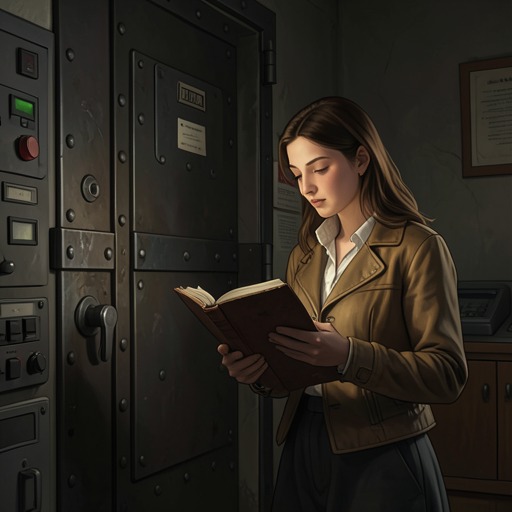
Billie's Convenience Store Encounter with Pierre
Cœur de slushBillie's Convenience Store Encounter with Pierre is the first sustained face-to-face meeting between Billie and Pierre, and it establishes their attraction through friction rather than easy intimacy. A hot walk for blue raspberry slush becomes a small contest over attention, manners, names, and silence: Billie wants to be left alone, yet repeatedly makes room for Pierre to stay. When he finally leaves without explanation, the scene’s tentative closeness turns into bewilderment.
The Walk to the Store
Billie is walking to a convenience store three blocks from home, thirsty for a blue slush and absorbed in a book whose words have made her hotter and thirstier. She is also daydreaming about an imagined future lover, a musician unlike the blond boy she is about to meet. The contrast matters: Pierre arrives not as the person Billie has pictured, but as a real, distracting presence who unsettles the fantasy before she can finish it.
A whistle interrupts her reading. Billie loses her place, steps on a crack in the sidewalk, and looks up to find Pierre across the street, walking backward with his hands in his pockets as he whistles a Joe Dassin song she likes in summer. His performance is deliberately irritating to her, but his blond hair and blue eyes also strike her as handsome. Her response is already divided: she resents him and finds him beautiful at once.
At the Counter
Pierre follows Billie into the store without speaking. He first occupies himself bargaining with the clerk over the price of fluorescent key chains; Billie, tired of listening, chooses the large slush. At the counter, Pierre counts out his money slowly, then turns to smile at her with the same eyes she remembers from the previous day. The delay and the look make an ordinary purchase feel like a forced pause between them.
He identifies her as the sister of someone else, a remark that angers Billie. She answers tersely, then asks why he is singing Joe Dassin. Their conversation begins in complaint and teasing rather than introduction. Pierre’s familiarity is premature in her eyes, while his attention keeps drawing her into an exchange she claims not to want.
When Pierre calls her timid, Billie throws her book at his face. He calls her crazy and retrieves it, rubbing the end of his nose. The gesture sharply changes the encounter’s tone: irritation becomes physical comedy, but the book also exposes how thoroughly Pierre has interrupted the quiet activity Billie meant to enjoy. She takes it back abruptly and presses it against her chest; sweat has marked one of its pages.
Names, Colors, and a Tentative Invitation
Pierre asks Billie’s name. She gives him Jacqueline, and he questions whether that is real. The name belongs to a brief imagining of another possible self, not a straightforward introduction. Billie regards Pierre’s face in the sunlight and answers him after a small sigh, allowing the exchange to soften without resolving her guardedness.
After finishing her slush in one go, Billie has a brain freeze and a deeply blue tongue and mouth. She brushes the sidewalk with her toes and draws a half-circle with her left foot, a subtle invitation for Pierre to continue walking beside her. He understands and joins her slowly. The gesture contradicts her earlier insistence that she only wants to drink her slush in peace: her resistance is real, but so is her curiosity.
They trade small questions, including their favorite colors. Billie chooses nail-polish red; Pierre chooses car yellow. The conversation is modest, but it gives the walk a momentary ease. Pierre then stops, sighs, and says goodbye. He takes three backward steps while looking at Billie with a forced smile, turns away, and tousles his hair in a half-hidden gesture of farewell. His departure comes without giving her time to answer. As he walks off, he whistles Bryan Adams’s “Summer of ’69.”
The Encounter Becomes a Memory
Billie remains standing two blocks from home, her book hanging from her fingers and her dress moving in the wind. She cannot make sense of Pierre. The scene names its own transformation: what began as a first Pierre moment becomes a Pierre memory as he disappears around the corner. The shift is not a settled romantic development but an emotional afterimage, made vivid by the abruptness of his exit.
Annette runs up behind Billie, breathless and wearing Billie’s dress, and points toward the end of the street to ask whether the departing boy was Pierre. Billie confirms it. Annette’s arrival gives the encounter an immediate witness and closes the scene on the name that has organized Billie’s attention. The meeting’s significance lies in that unresolved pull: Billie has objected to Pierre’s manners, thrown a book at him, and admitted him into her walk all the same, while his sudden retreat leaves her with questions rather than reassurance.